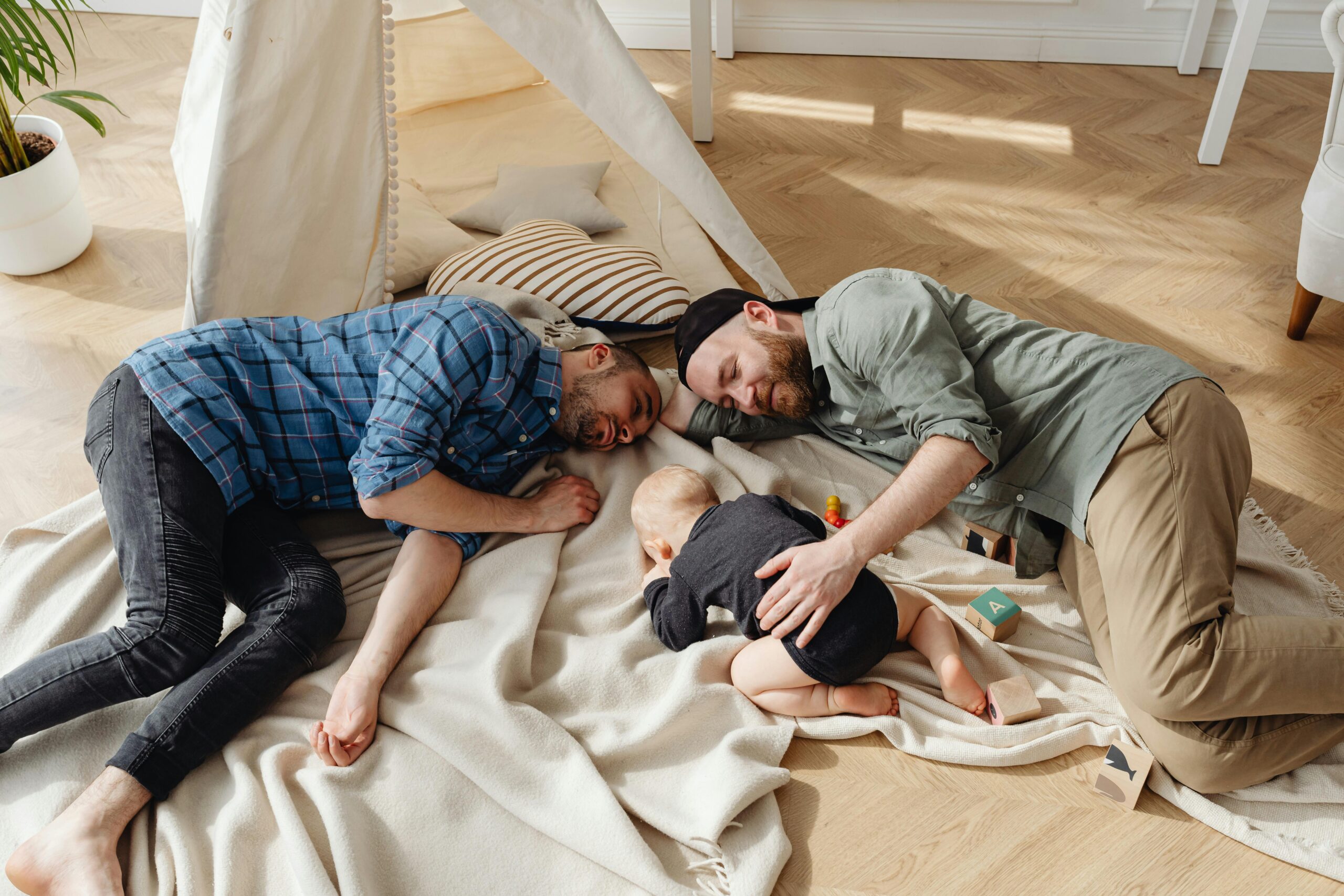
Not all families are the same, and we tend to think of family problems as personal or unique. While every family has its own history, how families differ, and how those differences shape our experience of love, safety, connection, and conflict share more in common than we think.
There’s a well-known line from Tolstoy: “All happy families are alike; each unhappy family is unhappy in its own way.” It’s an elegant phrase, but the truth is that both functional and dysfunctional families tend to fall into identifiable relational patterns.
What follows is a simple framework for five types of families. Think of them as existing along a spectrum ranging from low trust and cohesion to high trust and connection. These are not rigid categories. Most families move between them over time, depending on stress, life stage, and circumstance. Most likely you move through multiple family systems: your family of origin, family of choice, in-laws, and so on. It can be good to look at each family system in light of the categories below.
The family spectrum
1. Hurt and hurting families
Catchphrase: Everyone for themselves! And against each other!
At this end of the spectrum, families are defined by instability, hostility, and an absence of safety.
In hurt and hurting families, trust is extremely low or completely absent. Communication takes the form of criticism, blame, or aggression. In more severe cases, there may be emotional, psychological, or physical abuse. Power tends to be enforced through dominance rather than negotiated through respect.
One of the defining features of these families is that harm moves in multiple directions. It’s more than just one difficult person; the whole family system is reactive. Roles are unclear or constantly shifting. Boundaries are either too rigid (cut-off, avoidance) or too blurred (enmeshment, intrusion). There is little sense of “we” in this system. There are only individuals trying to protect themselves and survive.
Hurt and hurting families are often unstable over time. What holds them together is not connection, but the entanglements of shared history, obligation, and/or fear.
What it feels like in this family: walking on eggshells, bracing for conflict, never quite safe.
Important note: If a family system consistently feels unsafe or abusive, the priority is ensuring personal safety. That may include creating distance or leaving entirely.
2. Suffering families
Catchphrase: What’s in it for me? (usually unspoken)
Suffering families are less volatile, but still marked by low trust and fragile connections.
There may be moments of closeness, but they are inconsistent and often conditional. Family members can turn on each other quickly under stress, especially when individual needs feel threatened.
The dynamic here is often overtly or covertly transactional. Care and support are offered, but with conditions and expectations attached. When those expectations aren’t met, resentment builds. Boundaries tend to fluctuate. Sometimes interconnection feels overly involved, other times withdrawn.
There’s a sense of instability, though not always dramatic. Relationships can feel like they’re slightly off balance, with underlying tension that never quite resolves.
What it feels like in this family: uncertainty, emotional bargaining, a lingering sense of “something’s not quite right.”
3. Transactional Families
Catchphrase: We work because the arrangement works.
Transactional families are more stable over the longer-term, but that stability is organised around conditional trust.
Relationships function like agreements. Roles are clearer, responsibilities are handled, and daily life tends to run smoothly. Cooperation is possible and is sometimes even strong, but emotional depth is limited. Relationships stay at surface level.
These families often appear functional from the outside. They manage logistics well and are on top of finances, schedules, and responsibilities. But the connection is more practical than intimate.
When stress arises, support is offered if it aligns with individual interests. If it doesn’t, the limits of the relationship become more visible.
What it feels like in this family: predictable and stable, but emotionally thin or somewhat distant.
4. Relational Families
Catchphrase: We choose each other even when it’s hard.
In this family, trust and connection become central.
Relational families prioritise the relationship itself and not just what individuals get from it. There is mutual respect, emotional investment, and a willingness to support each other.
Conflict still happens, but the difference is in how it’s handled. Relational families orient around rupture and repair. When something breaks, there is an effort to understand, take responsibility, and reconnect.
Shared values play an important role, as do care, honesty, growth, and mutual support. Boundaries are generally healthy: individuals are respected as individuals while still being connected to the whole.
What it feels like in this family: safe enough to be real, supported in growth, and able to recover from conflict.
This type of family tends to be the most sustainable because it balances individuality with connection.
5. Philanthropic Families
Catchphrase: Your needs come before mine.
At this end of the spectrum are families built on deep care, generosity, and self-sacrifice.
Trust and respect are high. There is often a genuine desire to prioritise others and give without expecting anything in return. On the surface, this can look like the ideal.
The hidden risk of this type of family is that when self-sacrifice becomes the dominant pattern, it becomes unsustainable. Continually placing another’s needs above your own can lead to burnout, resentment, or loss of self. An example of a philanthropic family is a system that orients itself around a sick or dying family member. The family come together to maintain the situation but at the long-term cost of individual needs.
Healthy relationships require reciprocity and an ongoing exchange of giving and receiving. Without that, even the most loving dynamics can become strained.
What it feels like: deeply caring, but potentially exhausting or one-sided over time.

Which type of family is “best”?
It’s tempting to treat these categories as a hierarchy, but real families are more complex than that.
These are not fixed types. Families shift between them. A relational family under pressure might become more transactional. A philanthropic dynamic might emerge temporarily when one person needs extra support.
That said, some patterns are more sustainable than others:
- Hurt and hurting families are unsafe and often require distance or intervention.
- Suffering and transactional families can function, but often lack a deeper connection.
- Philanthropic families are caring but can become imbalanced.
- Relational families tend to offer the most stability and depth over time.
Moving Toward a More Relational Family
If you recognise aspects of your family in the less connected categories, that doesn’t mean things are fixed. These patterns change through small, consistent shifts.
1. Prioritise trust over being right
Many conflicts become about winning. Shifting toward curiosity and understanding can change the tone of interactions.
2. Name the pattern
Simply recognising what’s happening creates awareness. Awareness is the first step toward change. It may be as simple as naming “we shut down when things get tense” or “we only connect when things are going well”.
3. Focus on repair
Conflict is inevitable. What matters is what happens afterwards. Learning how to reconnect after disconnection is key.
4. Clarify shared values
What kind of family do you want to be? Naming this explicitly helps guide behaviour when things get difficult.
5. Balance giving and receiving
If the dynamic leans toward transaction or self-sacrifice, gently move toward reciprocity.
A Final Thought
Healthy families are not all the same. Some are quiet, others loud and expressive. Some are formal and highly structured, others are more flexible. What they tend to share is not sameness, but foundations of trust, respect, and the ability to repair when things go wrong.
You may not be able to change your entire family system. But you can change how you participate in it. Even small shifts towards more relationality can begin to reshape the dynamic.
And often, that’s where meaningful change begins.
If your family needs support, reach out to learn more about Family Therapy sessions.