
Relationship therapy intensives
Want change fast? We offer 1- and 3-day relationship intensives for you to deep dive and fast-track relationship healing and growth.


Imagine having 6 months of relationship growth in 3 days!
Also known as Marathon Relationship Therapy, these intensives are a condensed and focused approach to relationship therapy that provide you with dedicated time to go deeper than you would in a standard therapy session. We work intensely to address specific issues and give your relationship momentum.
Prior to the intensives we will meet online and go over your therapy goals and identify which issues need attention. You will complete a comprehensive relationship assessment and provide a full family and relationship history.
On the day, you will have ample time to talk in depth about the relationship in a way that cannot happen in traditional couple’s therapy. We work in a way where you don’t have to worry about needing to wrap things up before the session ends.
What happens...
You will have the opportunity to process any past hurts and wounds and understand their impact upon the relationship. You will also learn and practice new communication, conflict management and repair skills as well as develop resources to navigate each other’s attachment styles and stay co regulated.
After the intensive, you will receive a handout with everything covered and tips to build upon the experience. Three-day intensives also include a follow up session to track progress and fine tune anything that needs attention.
During these sessions we draw upon our extensive training in the Psychobiological Approach to Couple’s Therapy (PACT), Emotion Focused Therapy (EFT), Gottman Method and Family and Systemic Therapy to help create a safe space and find the tools and resources to support you.
Relationship intensives are good for couples who need immediate help and support in a sustained way or for couples who are starting out in therapy and want to get some runs on the board quickly. They are also suitable for couples living in remote or regional areas that would struggle to attend regular therapy sessions or for couples whose schedules do not allow for them to attend regular therapy.

Relationship intensives are good for :
Couples who need immediate help and support in a sustained way or for couples who are starting out in therapy and want to get some runs on the board quickly.
They are also suitable for couples living in remote or regional areas that would struggle to attend regular therapy sessions or for couples whose schedules do not allow for them to attend regular therapy.
Intensive fees
1-day intensive: $1700 (Saturdays only)
Includes 30-minute introductory call, initial assessment and 6 hours of therapy.
3-day intensive: $5000 (Friday-Sunday)
Includes 30-minute introductory call, initial assessment, 18 hours of therapy spread across 3 days and a 1-hour follow up session.








Frequently asked questions
If you’re considering therapy, you might have some questions about the process and what to expect. These questions might apply more generally and not just to working with me.
Below are some of the more frequently asked questions I get asked regarding psychotherapy…
Click on the question to expand the answer.
If you cannot find your question below, you might also like to look at the How I work page or contact me directly.
What will happen during the intensives?
Some of the things that you should expect during the intensives include:
- A full of assessment of your relationship dynamic as well as presenting issues, areas for growth and areas of strength, as well as an understanding of your individual attachment strategies and how they affect your relationship
- An assessment of how family of origin and previous relationships affect your relationship, particularly in relation to attachment strategies
- An opportunity to speak at length and in-depth about your relationship as well as space for any concerns you have regarding it
- The opportunity to go over your relationship aspirations
- Exercises to help create mutual understanding of each other’s ‘relationship wiring’ and to build capacity for self- as well as co-regulation
- Deconstruction of each partner’s non-verbal interaction and communication cues, so as to understand and read each other more effectively
- Assessment and interpretation of each partner’s individual communication style to manage or avoid miscommunication or conflict
- Learn how to mutually compromise in order to overcome the big relationship blocks
- Obtain tools for creating better sex and intimacy
- A deeper sense of relationship meaning and purpose
- Techniques to strengthen your ‘couple bubble’ and create a safer, more secure relationship
Who are intensives recommended for?
The 1-day intensives are suggested for couples who do not have significant issues affecting their relationship, who are not in crisis, but wish to work on their relationship. It is also suitable for couples who are beginning therapy and wish to make inroads quickly. Research on couples therapy suggests that “stacking” sessions at the beginning leads to quicker and longer-lasting change. The 3-day intensives are recommended for couples facing significant issues or who are in crisis.
Intensives are also recommended for couples living in remote or regional areas who would find it hard to attend regular couple’s therapy.
When are couples therapy intensives NOT recommended?
Intensives are not recommended under the following situations:
- Where there is active alcohol and/or drug addiction on the part of either or both partners, from either partner’s perspective
- Where there is serious and ongoing family violence in your relationship, including threats by one or both partners that violence might occur, or fear of violence occurring on the part of one or both partners. (Family violence includes the use of physical, emotional, verbal, sexual and financial violence)
- If one or both partners has a diagnosed and untreated mental illness (i.e. schizophrenia, borderline personality disorder, bipolar or recurrent major depressive disorder or psychotic disorders). This does not include previous, successfully treated psychotic episodes
- If there is an undisclosed, current affair that you are not willing to disclose (such secrets indicate relationship therapy failure) or an ongoing affair that the partner having the affair is not willing to end
- If one or both partners are currently experiencing suicidal or homicidal thoughts, or has a history of serious harm inflicted on themself or others
If you have any questions regarding suitability, please contact me for clarification about whether Intensive Couple’s Therapy is suitable for you.
What are your booking and cancellation policies?
For 1-day intensives, I require a $400 deposit to be paid within 3 days of receiving booking confirmation. If you need to cancel your booking, I request 48 hours notice. The booking deposit is non-refundable should you cancel your appointment within 48 hours.
For 3-day intensives, I require a $1000 deposit to be paid within 3 days of receiving booking confirmation. If you need to cancel your booking, I request 7 days notice. The booking deposit is non-refundable should you cancel your appointment within 7 days.
Frequently asked questions
If you’re considering therapy, you might have some questions about the process and what to expect. These questions might apply more generally and not just to working with us.
Below are some of the more frequently asked questions we get asked regarding psychotherapy.
Click on the question to expand the answer.
If you cannot find your question below, you might also like to contact us directly.
What happens in a session?
Everyone is different, so sessions will vary upon the presenting issues.
The first session involves a detailed assessment of your history and a discussion of goals and problems.
Ongoing sessions may involve a combination of talking, listening and education, games, exercises, trying out tools and techniques, and building emotional and nervous system capacity.
Sessions require your energy and commitment. We can provide tools and guidance, but we can’t do the work for you.
How often will I need to attend?
If there is too much of a gap between sessions, progress can be slow or minimal. On the other hand, having sessions too frequently can lead to burn-out.
If you are currently in a crisis, we would want to see you more frequently, possibly weekly, and not longer than fortnightly. Research on therapy also suggests that change occurs faster and lasts longer if sessions are stacked at the beginning.
For that reason, when we first work together and depending upon your needs, we generally suggest meeting weekly for 6-8 sessions, so that we can build rapport and develop momentum.
If more sessions are required, we will usually meet fortnightly or monthly depending upon your needs and circumstances.
How many sessions will I need?
It depends. Some people prefer to come to resolve a specific issue and are happy to go on with their lives. Others come for medium- to long-term therapy, which allows time and space to explore themselves and their relationships in greater depth.
During our initial session, we will discuss your goals and expectations and determine what suits you best.
How long will it take to see change?
Everyone is different and arrives with different needs. Some come to therapy looking for new tools or to move past a situation, while others come to resolve deep and long-standing wounds.
We are committed to working with you as efficiently as possible. We will discuss the duration and frequency of therapy in the first session. Using feedback informed treatment, we ensure that we stay on track at all times, so that your investment in your relationship is valued.
How do I know you're the right therapist for me?
Therapy depends on the strength of the relationship between you and your therapist. Research suggests that it accounts for about 40% of outcomes in therapy. For that reason, it’s essential to work with someone you feel like you click with.
We recommend reading our About Us pages to get a sense of us and how we work.
You can also book in a free 20-minute phone consultation, so we can discuss your needs and how we might be able to help.
Likewise, if we don’t feel that we are a good fit, we can refer you to another therapist who might be better suited.
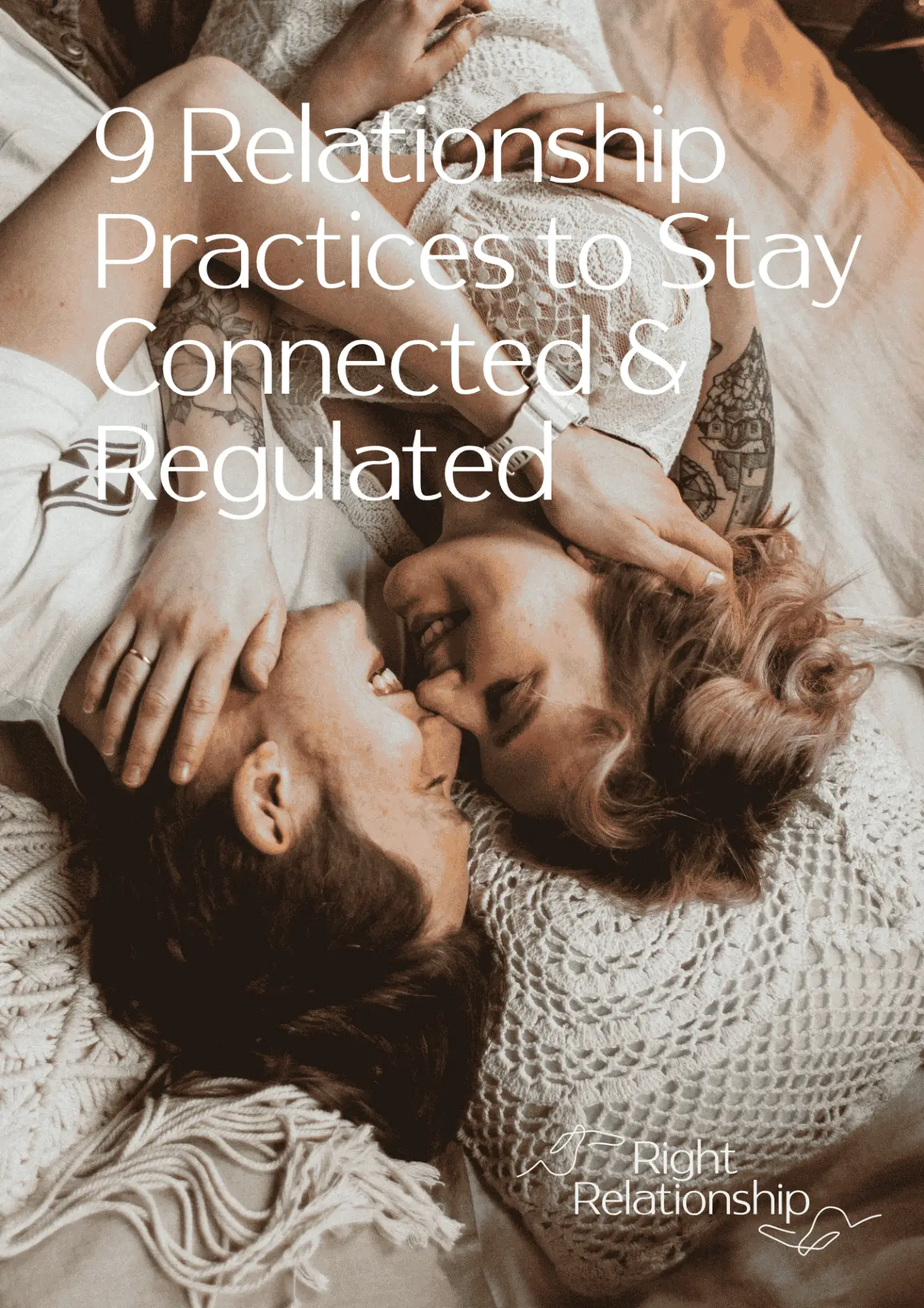

Download your free 14-page co-regulation guide
Download our free guide, 9 Relationship Practices to Stay Connected and Regulated, and discover simple, practical tools to improve connection, deepen emotional intimacy, and bring more calmness and presence into your relationship.
Take the First Step Towards Change
Healthy relationships are not about perfection. They are built through safety, understanding, communication and repair. Therapy can help you better understand yourself, your nervous system and the patterns that shape the way you connect with others.
Whether you’re seeking support individually or within your relationships, we offer a warm, non-judgemental space for growth, healing and deeper connection.