CNM & Polyam-Affirming Therapy
Non-monogamous relationships allow the opportunity to experience profound possibility and unique strain.


Love is always abundant, but our time and our capacity are not.
You might feel stretched between partners, agreements, and competing needs. You may be navigating jealousy, insecurity, or the fear of abandonment while trying to honour your values and autonomy. Perhaps you’re struggling with relationship asymmetries or spending energy negotiating time, energy, and emotional labour across multiple relationships.
Consensual non-monogamy (CNM) relationships bring complex systemic dynamics. Agreements can easily blur into rules and there is a fine line between veto power and subtle coercion. Triangulation and loyalty conflicts arise when partners feel pulled between competing attachments. Jealousy may be framed as personal failure, while compersion is over-idealised as an aspiration when both are normal human responses.
Attachment frameworks may not map neatly onto multi-partner systems. You might find yourself asking: How do we create security across a network? What does commitment look like when there are multiple bonds? How do we honour individual autonomy without eroding relational safety?
These issues are indications that you are travelling without a roadmap towards something complex and unsupported.
How CNM & polyam-affirming therapy supports you
Whether you identify as monogamish, polyamorous, solo-poly, or relationship anarchist or if you’re exploring consensual non-monogamy (CNM) for the first time, you may carry the weight of misunderstanding from friends, family, or previous therapists. If you’ve previously encountered mononormative judgment, pathologizing, or pressure then reaching out for support can feel risky.
We offer a space where you can slow down and make sense of what is happening beneath the surface of conflict. Rather than treating jealousy, insecurity, or conflict as problems to eliminate, we explore what they are signalling: unmet needs, unclear agreements, nervous system overwhelm, or underlying attachment needs.
We can help you learn to distinguish agreements from rules, how to create relational agreements that are consensual, flexible, and rooted in shared values rather than fear. We can explore both explicit and implicit power dynamics so that autonomy and care can coexist without coercion.
If you are navigating relationship asymmetry, we can explore how fairness differs from sameness, and how to build security even when partners’ experiences diverge. If you are facing triangulation or loyalty conflicts, we work toward clarity of roles, boundaries, and communication pathways that reduce pressure on any one relationship to carry the entire system.

How CNM & poly-affirming therapy supports you
We also support you in developing a language for needs, limits, and desires. We help you practice communicating even when conversations are difficult. You will develop tools for negotiating agreements that reflect your values rather than your fears. You will learn to navigate jealousy, asymmetry, and conflict without collapsing into blame or withdrawal. You will learn how to build autonomous and secure relationships.
Importantly, we recognise intersectionality. Your experience of non-monogamy may intersect with queerness, gender diversity, neurodivergence, disability, cultural background, or parenting responsibilities. These factors are not treated as complications but as integral aspects of your relational ecology.
Over time, therapy helps you move from crisis management toward intentional relationship design that supports resilience.
Most importantly, you will leave with a felt sense that your way of loving is not inherently flawed or doomed to fail. With the right support, CNM relationships can be intentional, resilient, and deeply nourishing. The research says that, when done right, people in CNM relationships are not relationship disasters but relationship masters!
The relief of being seen and understood
You deserve a space where you don’t have to defend the legitimacy of your relationships before you can begin the real work.
In CNM and polyam-affirming therapy, you are never asked to justify your relationship structure. Instead, we begin from the understanding that consensual non-monogamy is a valid and meaningful way of organising love, intimacy, and kinship.
There is no top-down or hierarchical model to adhere to. Every relationship system is different, and we want to support you to find tools and solutions that serve your system.
Many clients describe the greatest relief as no longer having to explain or defend their relationships. In a CNM- and polyam-affirming space, you can speak freely without fear of judgment.
How therapy is structured
CNM & poly-affirming therapy can involve individuals, couples, or multiple partners, depending on your needs. We work systemically, exploring how each relationship influences the wider network, while maintaining clear boundaries and confidentiality.
Sessions may focus on:
- Clarifying values and relationship visions
- Mapping agreements and identifying pressure points
- Building communication practices that support multiple bonds
- Strengthening nervous system regulation during conflict
- Exploring attachment patterns across relational systems
Where appropriate, we support you to create practical frameworks you can use between sessions: agreement templates, communication tools, check-in structures, rituals, and strategies for navigating transitions such as new partners, breakups, or changes in capacity.
What makes us different
What sets us apart is our focus on relationships as systems. Because CNM is inherently systemic and polycules are systems within systems, our training and perspective is better equipped to provide relationship support than most mainstream, behavioural approaches to relationship therapy.
Furthermore, behavioural changes don’t stick when relationships become heated or over-stretched. There’s a saying in psychology: we regress under stress. This is why the demands of multiple relationships become more difficult when there is stress or conflict within the relationship system.
Our approach draws heavily from the Psychobiological Approach to Couples Therapy (PACT), which works deeply with how our brains, bodies and neurobiology respond when under relational stress. We support you from the inside out, helping you de-escalate stress responses and the flight-or-fight reaction to co-create a safe environment for relating.
We also make use of regular feedback informed treatment (FIT) during and after sessions, in the form of short surveys and assessments. FIT ensures that your therapy stays on track and addresses any therapeutic drift before it happens. Research shows that the use of FIT increases the likelihood of positive therapy outcomes by a factor of 2.5.

Frequently asked questions
If you’re considering therapy, you might have some questions about the process and what to expect. These questions might apply more generally and not just to working with us.
Below are some of the more frequently asked questions we get asked regarding psychotherapy.
Click on the question to expand the answer.
If you cannot find your question below, you might also like to contact us directly.
What happens in a session?
Every relationship is different, so sessions will vary upon the presenting issues.
The first session involves a detailed discussion of your goals and problems and assessment of the issues.
Ongoing sessions may involve a combination of talking, listening and education, games, exercises, observing relationship dynamics, trying out tools and techniques, and making bids for connection and repair. Sessions are intensive and you will be supported to proactively work together on your relationships.
Sessions require your energy and commitment. We can provide tools and guidance, but we can’t do the work for you.
How do we know you won't take sides?
We believe that in most relationships, there are no “angels” or “devils.” Instead, there are only negative cycles and patterns of relating, which we can work on together.
For relationship therapy to progress, it’s important that everyone feels safe. You need to feel seen, heard and appreciated and know that you are welcome unconditionally. We go out of our way to ensure that the therapeutic alliance feels balanced. We use feedback informed treatment to ensure that you feel it is balanced also.
How long will it take to see change?
Every relationship is different and arrives with different needs. Some come to therapy looking for new tools or a relationship ‘tune up’, while others come to resolve deep and long-standing wounds.
We are committed to working with you as efficiently as possible. We will discuss the duration and frequency of therapy in the first session. Using feedback informed treatment, we ensure that we stay on track at all times, so that your investment in your relationship is valued.
Do you have to see all partners together for CNM or polyam-affirming therapy?
No. Therapy may involve individuals, couples, or polycules depending on consent, logistics, and what feels most useful.
Many people begin individually or as a couple to clarify their needs and agreements before inviting other partners into sessions. When multiple partners attend, the focus is on supporting the health of the wider relationship system while maintaining clear boundaries and confidentiality.
Do you work with sex or sexuality?
Yes! Many relationship therapists have little or no training when it comes to sex issues in relationships or feel embarrassed to discuss them.
We have not only done training in sex therapy issues, we’re also not afraid to talk about sex. In fact, we will ask you in the first session if it’s an area that needs to be addressed.
Sex is a natural part of relationships, and we can work with you on any sex or sexuality issues you’d like to work through.
Do we already have to be CNM or polyam?
No. Couples who are about to step into the world of non-monogamy often come to develop security or tools to start opening their relationship. Likewise, we see many couples who are monogamous but might occasionally play apart, who need support with agreements, boundaries and other issues that may arise.
Will you try to force us to be monogamous?
No. CNM-affirming therapy does not place monogamy upon a pedestal as something to be aspired towards. We also don’t place non-monogamy on a pedestal, either.
Your relationship style and structure are your choices to make. End of story.
The purpose of therapy is to help you build relationships that align with your values, whether that includes polyamory, monogamish, or any other form of consensual non-monogamy. If your relationship structure changes over time, that evolution is explored with care rather than imposed as an outcome.
Is jealousy a sign that CNM isn’t right for me?
Jealousy is a human emotion, not a failure. Nor is it proof that non-monogamy cannot work.
In therapy, jealousy is approached as a signal pointing to underlying needs, fears, or attachment concerns. By understanding what jealousy is communicating, you can respond with clarity and self-compassion.
How do I know you're the right fit for us?
Therapy depends on the strength of the relationship between you and your therapist. Research suggests that it accounts for about 40% of outcomes in therapy. For that reason, it’s essential to work with someone you feel like you click with.
We recommend reading the About Us pages to get a sense of us and how we work.
You can also book in a free 20-minute phone consultation, so we can discuss your needs and how we might be able to help.
Likewise, if we don’t feel that we are a good fit, we can refer you to another therapist who might be better suited.

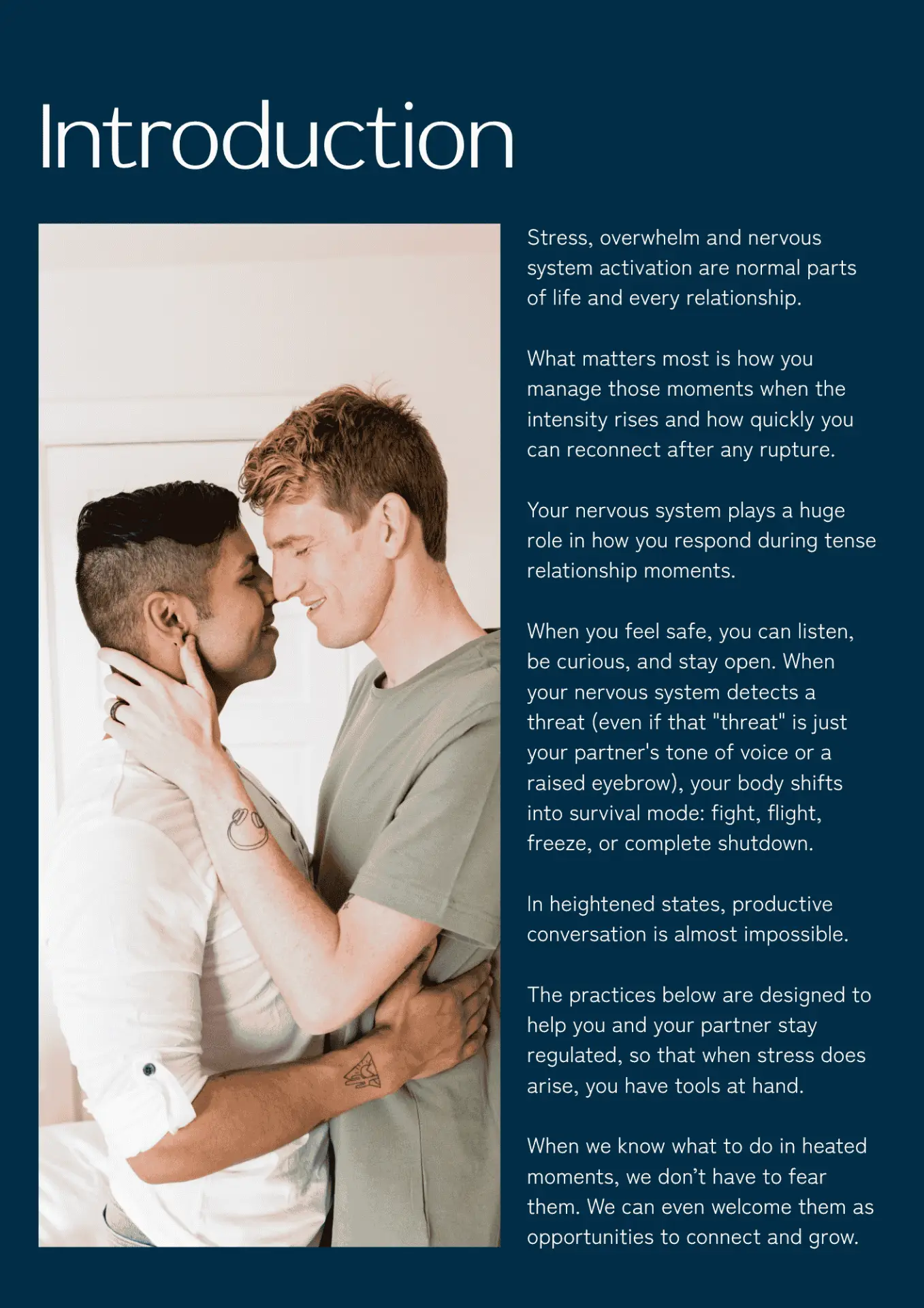
Download your free 14-page co-regulation guide
Download our free guide, 9 Relationship Practices to Stay Connected and Regulated, and discover simple, practical tools to improve connection, deepen emotional intimacy, and bring more calmness and presence into your relationship.
Take the First Step Towards Change
Healthy relationships are not about perfection. They are built through safety, understanding, communication and repair. Therapy can help you better understand yourself, your nervous system and the patterns that shape the way you connect with others.
Whether you’re seeking support individually or within your relationships, we offer a warm, non-judgemental space for growth, healing and deeper connection.